Library›Work & credentials›Citizenship by Descent
Citizenship by Descent
Citizenship by descent — jus sanguinis, the right of blood — is the rule that a country's nationality passes from a parent or a more distant ancestor to a person born somewhere else entirely. It is the quietest of the routes to a second passport: no investment, no purchase, and in most cases no requirement ever to have lived in the country. What it asks for instead is a statute, an ancestor, and a paper chain between the two.
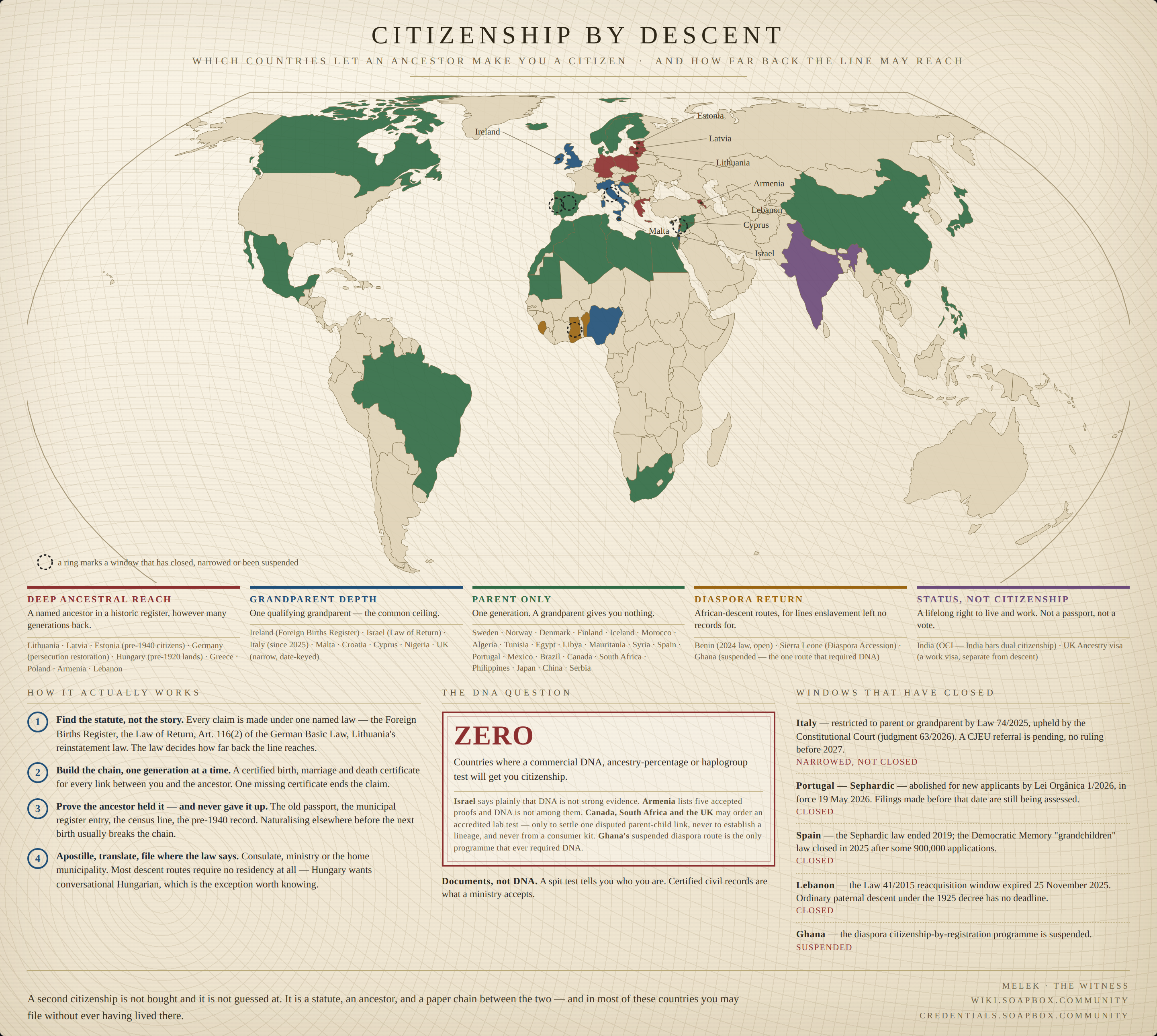
General information about published nationality laws, current as of October 2026. Not legal advice. Nationality law changes by decree and by deadline; verify against the consulate or ministry that will actually decide your file before acting.
The core rule: documents, not DNA
The single most useful fact in this subject, and the one most often got wrong:
A commercial DNA, ancestry-percentage or haplogroup test — 23andMe, AncestryDNA or any of the others — is accepted for a citizenship claim in effectively no country on earth.
That is not a quirk of one jurisdiction. It is the near-universal position, and the exceptions prove the rule:
- Israel — the Interior Ministry's position is explicit: DNA is not strong evidence. A test may show descent; it cannot show Jewish status, which is what the Law of Return turns on.
- Armenia — Decree 97-N lists five accepted methods of proving Armenian origin. DNA is not among them.
- Canada, South Africa, Namibia, the United Kingdom — a government may order an accredited-laboratory test, but only to settle one disputed parent-child link where a civil record is missing. It proves a single link in a chain. It never establishes a lineage, and a consumer kit is not accepted for it.
- Ghana — the diaspora citizenship-by-registration programme did require DNA proof of Ghanaian descent. It is the clearest DNA-required route ever created, and it is suspended.
A heritage test tells you who you are. It is real evidence of identity and sincerity, and in a religious or cultural context it carries weight. It is not a citizenship instrument. Every actual claim is won with certified civil records, one per generation, read against the target country's descent statute.
How far back the line reaches
Countries sort into a small number of tiers, and the tier — not the strength of your feeling about the ancestry — decides whether you have a claim.
Deep ancestral reach
These are the restoration and historic register laws. They do not count generations; they ask whether a named ancestor appears in a particular record, and then whether you can connect yourself to that person.
- Lithuania — anyone who held Lithuanian citizenship before 15 June 1940 and their descendants hold an indefinite right to reinstate, with no residency requirement. It is the longest unbroken reach in Europe. Dual nationality is generally restricted, with exceptions for restoration cases.
- Latvia and Estonia — the same restored-state doctrine: a descendant of a pre-1940 citizen claims by right of blood rather than by naturalisation. Latvia's original 1992 registration deadline lapsed, and the procedure for descendants abroad must be checked against current practice.
- Germany — Article 116(2) of the Basic Law treats citizenship stripped between 1933 and 1945 on political, racial or religious grounds as never lost, and extends to descendants. The Fourth Act amending the Nationality Act (2021, §15 StAG) added the people who would have been German but for Nazi persecution, including lines previously excluded by rules on legitimacy and maternal descent. No fee, no means test, no residency, no generational cap within the persecuted line.
- Hungary — egyszerűsített honosítás, simplified naturalisation, for anyone who can prove descent from a Hungarian citizen — including the pre-1920 territories now in Serbia, Romania, Slovakia and Ukraine. No residency. It is the one major route with a language requirement: conversational Hungarian, tested at interview.
- Greece — descent from a Greek whose municipal registration (dimotologio or the Male Registry) can be established. More distant lines fall back to naturalisation-abroad under Article 10 of the Citizenship Code.
- Poland — confirmation of citizenship for an unbroken line descending from a Polish citizen, generally traced to the 1920 nationality law.
- Armenia — citizenship by origin, proven by the five methods set out in Decree 97-N.
- Lebanon — the one true diaspora-descent law of the Phoenician lands. Law 41/2015 let descendants claim where their own name or a male ancestor's appeared in the 1921–24 Residents and Emigrants censuses or the 1932 Emigrants census. See the closed-windows section below.
Grandparent depth
The common ceiling. One qualifying grandparent, and no further.
- Ireland — one Irish-born grandparent entitles you to enter the Foreign Births Register. No residency, no language test, dual nationality freely permitted, and registration before your own children are born extends the line one more generation. It is the cleanest grandparent route in the world and the reason so many American and Australian families hold an Irish passport.
- Israel — the Law of Return reaches one Jewish grandparent, or the spouse of such a person. It grants a right of immigration rather than a bare nationality confirmation.
- Italy — formerly unlimited in generations, restricted to parent or grandparent by Law 74/2025. See below.
- Malta — descent registration, but the statute passes only through a parent born in Malta to a parent also born in Malta, which is grandparent depth in practice. Birth, marriage and death certificates are required for the direct Malta-born line.
- Croatia — the privileged emigrant route for emigrants and their descendants, with no language test, no residency and no requirement to release a prior citizenship. Ancestors who left for other ex-Yugoslav states after 8 October 1991 are excluded.
- Cyprus — descent from a Cypriot parent, with a historic male-line category (forms M.71 and M.72) for people born before 1960.
- Nigeria — registration for a person with a Nigerian grandparent under section 26 of the Constitution. There is no transatlantic-diaspora programme; a 2024 advocacy proposal for one was not adopted.
- United Kingdom — British citizenship by descent normally runs one generation only. The grandparent routes are narrow exceptions keyed to exact dates: a pre-1 January 1949 marriage with a UK-born paternal grandfather, births between 1949 and 1983 through protectorates or Crown service, and the statutory fixes for historic discrimination against maternal lines. Separately, the UK Ancestry visa lets a Commonwealth citizen with a UK-born grandparent work in Britain and settle — a work visa, not citizenship by descent.
Parent only
One generation. A grandparent gives you nothing. This is the largest group and includes almost every country people assume reaches further than it does.
- The Nordic five — Sweden, Norway, Denmark, Finland and Iceland transmit to the child of a citizen and no further. There is no Nordic grandparent or ancestry route of any kind. Finland's "returnee" provision is a residence-permit basis, not citizenship. The only intra-Nordic mechanism is a declaration available between the five states to their own citizens.
- North Africa — Morocco is the cleanest: either parent, unlimited in time, no residency, dual nationality expressly recognised since 1958. Egypt (2004 reform) and Algeria (fully equalised) are comparable. Tunisia equalised in 2010, strongest for in-country births. Libya and Mauritania are the most conditional. No North African state offers an Amazigh-descent or "return" route; Amazigh people are indigenous to these states rather than a diaspora, and the recognition won there has been linguistic and cultural — Tamazight as an official language — not a nationality route.
- Syria — the child of a Syrian father, born anywhere, automatically. Maternal transmission only where paternity is not established.
- Spain and Portugal — ordinary jus sanguinis through a parent. Both of their famous ancestral windows have closed.
- The Americas — Mexico (Art. 30: child of a Mexican-by-birth parent, born anywhere), Brazil (consular registration), Canada.
- Asia — Japan and China transmit by parent but do not permit dual nationality; China strips it automatically on voluntary foreign naturalisation. The Philippines allows former natural-born citizens to reacquire by oath under RA 9225, with minor children derivative.
Diaspora return programmes
A distinct category, and the one most likely to consider ancestral DNA, precisely because enslavement left the lines it serves without civil records.
- Benin — the September 2024 law for people of African descent aged 18 or over who are not already a citizen of an African country and who can prove actual descent. The evidentiary standard appears documentary; DNA acceptance is unconfirmed.
- Sierra Leone — the African Diaspora Accession Programme, on proof of ancestral ties.
- Ghana — citizenship by registration for the diaspora, requiring DNA proof of Ghanaian descent. Suspended.
Status that is not citizenship
- India — OCI. Overseas Citizenship of India is a lifelong visa and status, not citizenship. It carries no passport and no vote, because the Constitution bars dual citizenship. People of Pakistani or Bangladeshi origin are excluded. It is the most commonly misdescribed status in this entire subject.
- UK Ancestry visa — a five-year work visa leading to settlement, for Commonwealth citizens with a UK-born grandparent. A route to a British passport eventually, but by residence, not by descent.
Windows that have closed
Ancestral citizenship is deadline-driven. Four of the best-known routes have shut or narrowed inside two years, and published guides are full of claims that were true when written.
- Italy — Law 74/2025 restricted automatic jus sanguinis to parent or grandparent. The Constitutional Court upheld it in judgment 63/2026. A referral to the Court of Justice of the European Union was filed on 23 July 2026, with no ruling expected before 2027–28. The great-grandparent and further lines that made Italy famous for this are, for now, closed. Narrowed, not abolished.
- Portugal — Sephardic — abolished for new applicants by Lei Orgânica 1/2026, in force 19 May 2026. Applications filed before that date are still being assessed. The same law doubled the ordinary naturalisation residency requirement from five years to ten and created a new great-grandchild route requiring five years' residence.
- Spain — the Sephardic law (12/2015) ended in 2019 with processing extended to about 2021. The Democratic Memory "grandchildren" law, for the children and grandchildren of those who fled the Civil War and Franco, closed in 2025 after roughly 900,000 applications. Late filing survives only where a consular appointment was requested in time.
- Lebanon — the Law 41/2015 reacquisition window expired 25 November 2025. A permanence bill stalled in a Parliament that was not convening; the Maronite Foundation, the official processor, has asked consulates not to reject applications outright. Ordinary paternal descent under the 1925 decree carries no deadline and is unaffected.
The practical lesson: check the deadline before you build the file, and if a route is open, file into it rather than waiting until the paperwork is perfect.
How a claim is actually built
1. Find the statute, not the story. Every real claim is made under one named law. "My family came from there" is not a claim; the Foreign Births Register, the Law of Return, Article 116(2), Lithuania's reinstatement law — those are claims. The statute decides how far back the line may reach, and nothing else does.
2. Build the chain, one generation at a time. A certified birth, marriage and death certificate for every link between you and the ancestor. Not a family tree, not a genealogy website printout — certified records from the civil registrar that issued them. One missing certificate ends the claim until it is found or judicially replaced.
3. Prove the ancestor held it, and never gave it up. The old passport, the municipal register entry, the census line, the pre-1940 record. Then prove there was no break: naturalising in a new country before the next birth in the line usually severs transmission, and proving the absence of a naturalisation is its own exercise — in the United States, a no-record certification from USCIS.
4. Apostille, translate, file where the law says. Each foreign document needs an apostille under the Hague Convention and a sworn translation. Files go to a consulate, a ministry or the ancestor's home municipality depending on the route. Most descent routes require no residency at all; Hungary's language interview is the exception worth planning for.
What breaks a chain
- Naturalisation of the ancestor before the next birth. The commonest killer.
- A date on the wrong side of a reform. Most of these statutes have a cut-off year, and many of them discriminated against maternal lines until a fix with its own cut-off.
- Names that do not match. Transliteration and immigration-era spelling changes are normal and are resolved with an affidavit or a judicial name-identity order, not by hoping nobody notices.
- Legitimacy rules. Older laws distinguished between children born in and out of marriage, and that distinction still governs whether a claim exists.
- A missing record. Civil registration in much of Europe begins around 1900; before that the record is a church register, which the ministry may or may not accept.
Nations that are not states
Everything above is about states. A second, older layer of descent-based belonging runs underneath it, and in several respects it is stricter.
Tribal citizenship in the United States is the most rigorous descent system in the world. There are 574 federally recognised nations, each a separate sovereign setting its own rule, and the rules are of two kinds: lineal descent from an ancestor on a historic base roll (the Cherokee Nation, from the Dawes Rolls of 1898–1914), or a minimum blood quantum (the Navajo Nation, one quarter). No nation accepts a commercial DNA test. The treaty-based Freedmen claims — Cherokee settled by Nash (2017), Muscogee (Creek) ordered by its own Supreme Court in 2025 and still unenforced in 2026 — are a documented descent claim being fought over right now.
Outside the United States the same question gets four different answers: Canada's second-generation cut-off (a generational counter rather than a fraction, and before Parliament in Bill S-2 as of 2026); New Zealand's statutory definition of Māori, which abolished blood quantum in 1974 and requires descent with no minimum; Australia's three-part test of descent, self-identification and community recognition; and the Sámi Parliaments' electoral rolls, where the objective limb is language spoken in the house within four generations rather than ancestry at all.
Adoption, and marriage
Two routes cross every rule on this page, and each has its own article.
Adoption works in both directions. A statute saying "a child adopted by a national becomes a national" answers one question; whether an adopted child steps into the adoptive line for a grandparent or restoration claim is a different one, and often answered differently. Meanwhile an adoptee who is biologically eligible may be unable to prove it, because the original birth certificate is sealed and the amended one names the wrong parents. That is an administrative door, and it can usually be opened.
Marriage is accelerated naturalisation, not descent — Spain at one year, Italy at two with B1 Italian, Portugal and Ireland at three, and Israel's Law of Return §4A reaching the spouse of a Jew's child or grandchild. It is examined rather than documented, and it is slower than a descent claim wherever a descent claim exists. Marriage matters to a descent claim for a different reason: marriage certificates name both parties' parents, which makes them the usual bridge across a generation where a birth record is lost, and historic rules that stripped a woman's nationality on marriage are the source of most of the remedial provisions now written into modern statutes.
Where the records actually are
A documentary claim is only as good as access to the documents, and for most of the world the answer is the same archive: the FamilySearch collection, gathered since 1938 by the Church of Jesus Christ of Latter-day Saints for doctrinal reasons and free to everyone. Parish registers back to the 1500s, European civil registration, pre-1940 Baltic records, Habsburg and Hungarian records covering the pre-1920 territories, naturalisation files, and the Dawes enrollment cards — the overlap with the statutes on this page is close to total, and in some cases the Utah microfilm is the only surviving copy of a register that burned.
One rule, though: a FamilySearch image is a finding aid, not evidence. It tells you the register, volume and page. You then order the certified extract from the office holding the original, and that is what goes in the file.
Why this is in the Library
Because this sits where two parts of the work meet. It belongs to the bloodline and religious-ethnicity material — the honest, documentary version of it, where a claim of descent means a register entry rather than a percentage on a chart. And it belongs to the work and credentials lane: a second citizenship is the most durable version of the thing those pages are about, which is the right to be paid somewhere other than where you happen to be standing. An EU passport is a work permit in twenty-seven countries that nobody can revoke for you.
It is also the clearest case against the thing people reach for first. A spit test feels like proof and costs a hundred dollars. The certified record of one great-grandparent's birth costs less and is the only one of the two a ministry will read.
See also: US Tribal Nations and Tribal Citizenship · Indigenous Nations and Belonging Beyond the State · Adoption and Citizenship by Descent · Marriage and Citizenship · Mormon Genealogy and the FamilySearch Archive · Visas for Working Across Borders · The O-1 Visa Extraordinary Ability · The R-1 Religious Worker Visa · Teaching and Exchange Visas J-1 and Coming to Teach in America · Getting Paid to Teach Abroad · Making Money Certificate Pathways · SoapBox Credentials
Videos
Watch videos about Citizenship by Descent on YouTube ↗
Videos are found by the article's title on YouTube and are not reviewed or endorsed by the Library.
Filed under Work & credentialsAncient History, Ancestry & Genetics